Recent news

jesper. Theme images by Storman. Powered by Blogger.

Text Widget

Total Pageviews

Labels

Navigation-Menus (Do Not Edit Here!)

lazada banner

Advertisement

Page Rank

revenue popunder

revenuehits.com

h12 banner

Social

Text Widget

Popular Posts

Pages

Services

Random Posts

Showing posts with label hardware. Show all posts

Friday, July 8, 2016

NVIDIA announces GeForce GTX 1060 for $249

- No comments


NVIDIA has announced the successor to the GTX 960 of last year and the latest in the new 10-series, the GeForce GTX 1060. This will be NVIDIA's latest bang-for-the-buck card and will compete with AMD's recently announced RX 480 in the mainstream segment.


The GTX 1060 is NVIDIA's latest graphics card to be based on the company's current generation Pascal architecture. The card claims to offer up to 3x the performance of its predecessor, the GTX 960, but that's mostly in VR, although NVIDIA still claims roughly 2x improvement in standard 2D gaming in titles such as Rise of the Tomb Raider (DX12), The Witcher 3, and Overwatch.

The 1060 has 1280 CUDA cores with a base clock of 1506 MHz and boost clock of 1708 MHz. You get 6GB of GDDR5 memory clocked at 8Gbps, 192-bit memory bus width and 192 GB/s memory bandwidth. In comparison, the RX 480 ships in 4GB and 8GB configurations.

Connectivity wise you get DisplayPort 1.4, HDMI 2.0b, and Dual Link-DVI with maximum supported resolution of 8K at 60Hz. TDP is 120W and the card takes its power from a 6-pin connector.

The 1060 has full support for NVIDIA features such as simultaneous multi-projection, Ansel, G-Sync, GPU Boost 3.0, and GameStream but there is no SLI support.

The 1060 will be available in two variants. There will be the standard OEM variant, which will come in many shapes and forms, and then the Founders Edition, which will be available directly from NVIDIA and feature the NVIDIA reference design and cooler.

The prices for the 1060 start at $249 for the OEM variant and $299 for the Founders Edition.

Thursday, June 23, 2016

- No comments
Most people haven't seen medium format cameras in person as they are expensive and only really used by professionals. But other than the price they are also known to be quite big due to their sensor size. Hasselblad has been making medium format cameras for decades now and all their cameras are also fairly large.


Well, not anymore. The company has just launched its first mirrorless medium format camera, which completely changes the way a medium format camera is supposed to look and handle. Smaller than most full frame DSLR cameras, the new X1D is the smallest model in the company's lineup and could pass off as any old mirrorless camera if you ignore the badge and don't know what's lurking inside.

The camera is exquisitely hand made in Sweden from milled aluminum that forms the frame of the camera, with a deep handgrip on either side for a secure grip. The camera only weighs 725g, which is lighter than the Canon 5D Mark III. The back has a 2.4 megapixel electronic viewfinder as well as a 3.0-inch 920k dot touchscreen with simple iconography that should make it easy to use this camera.


Inside, however, lies the company's 50 megapixel medium format sensor that has a dynamic range of 14 stops with 16-bit color, ISO 100 to 25600 range, and a shutter speed of 1/2000 of a second to 60 minutes. Along with images, the camera can also record 1080p video at 25fps.

The X1D has two SD card slots to save your images. On the connectivity front, Hasselblad has included USB 3.0 support, Wi-Fi ac, and GPS.


With a reduced flange distance, the older lenses would no longer be compatible, so the X1D comes with its own series of lenses, with two being available at the moment. There is a 45mm f3.5 and a 90mm f3.2, priced at $2,295 and $2,695, respectively. Should you choose to use your older lenses you will need an H lens adapter.

Now for the price. The Hasselblad X1D is priced at $8995 body-only. The 45mm f3.5 kit lens bundle will set you back by $11,290 and the bundle with both the lenses and the camera will cost $13,985. Demos will be available in July and deliveries a month later.

Monday, June 20, 2016

Hyperkin’s Smart Boy Turns Your Android Smartphone Into A Working Game Boy

- No comments


Video game peripherals manufacturer, Hyperkin first teased the world with an announcement of the Smart Boy. From what was first an April Fools’ joke, seeing the amount of interest and traction the Smart Boy is getting, the device has now turned into an actual product.

Hyperkin’s Smart Boy is basically an enclosure that turns your smartphone into a working Game Boy. It’s so authentic that there’s even an actual slot at the back for you to slot in game cartridges, which will load games into the phone.


In its initial announcement, Hyperkin first made the Smart Boy for the iPhone. However, the working model of the Smart Boy showcased at this year’s E3 was using a Samsung device instead. In its defense, the company did announce that the Smart Boy would arrive on Android smartphones.

The Smart Boy is an interesting product to see from the many more modern devices being launched these days. We’re not sure how the device works, but we’re guessing that the enclosure has a special adapter that converts and transfers data from the game cartridge to the phone via a microUSB port.


No pricing information has been revealed about Hyperkin’s Smart Boy, but the device is slated for release in December 2016. How many of you still keep your Game Boy cartridges?

(Source: Neowin)

Friday, June 17, 2016

Luma: The Router That Tracks And Records Every Website You Visit Is Now Available For Sale

- No comments
Luma’s first ever product announced globally back in late 2015 is now finally ready to go on sale and the debut product will be rolling out for sale the general public soon. Luma is one of the very few companies around the world which are basically working to change the concept of how home Wi-Fi works, with multi-unit routers and cool apps.


Luma units can now be bought for a price of $149

Luma’s debut product’s units began shipping yesterday. The units are also expected to be found at Best Buy stores later this summer. The single Luma router can be bought for as low as $149 only. However there are even better options that will not only help you save a few bugs but also it will allow you to improve the connectivity across your home by using multiple unit stations, the multi units pack of three routers will cost only $399.

Luma not only offers an amazing Wi-Fi Connectivity option but also provides a robust and fool proof parental control check with it. Parents who use the Luma routers can block whichever websites they want and can also view the browsing history of everyone (rather the growing teenagers in their home).


The extremely powerful features of Luma router also alarm the users for requests like opening a blocked website, etc. This will not only let you know but also chat with them to ask for reasons why they want to open the blocked website. However on the other hand this is as freaky a feature as could be, because one of the house mates can continuously spy on the rest without even letting them know, since the feature cannot be permanently turned off in any way possible.

The company also unveiled how it is working on skills for Alexa, so that the people who own Amazon Echo will then be able to control their router using voice activated commands. According to the company, the first command i.e. “Alexa, pause the internet,” will be rolled out to use in the coming weeks.


Friday, June 10, 2016

EK Lists Down The Availability of Liquid Cooling Blocks For Custom GTX 1080 Cards

- No comments


Even though NVIDIA GeForce GTX 1080 has only entered the market few weeks ago, the Slovenian company EK Water Blocks has already prepared early on to welcome it with a selection of full-cover liquid cooling solution for GTX 1080 Founders Edition cards. Since the custom version of GTX 1080 cards are starting to appear on the market, the company has recently announced that it is prepping up similar solution for such cards.

According to the announcement, the liquid cooling blocks that the company will release soon are designed to be compatible with GTX 1080 cards from MSI, ASUS, Gigabyte, Palit and EVGA. The actual list is shown below:


However, EK didn’t reveal the price tag of these liquid cooling blocks in its announcement though. As a reference, the liquid cooling block that is designed for GTX 1080 Founders Edition is currently priced at USD 113.99 (about RM 465) onwards through EK’s own web store.

Meanwhile, EK has also stated that it is working to release water blocks for more custom GTX 1080 very soon. So, stay tuned if your GTX 1080 is not in the list above.
(Source: EK Water Blocks)

Monday, June 6, 2016

Bose has announced four new products today, two of which are noise-cancelling and two for sports wear.

- No comments

The first is the QuietComfort 35, a wireless variant of the popular QuietComfort 25. The two are nearly identical, except now they are completely wireless and you get 20 hours of battery life with the Bluetooth enabled, or more if you choose to use a cable. The QuietComfort 35 is priced at $350.


Next is the QuietControl 30, which is a pair of wireless earphones that sit behind your neck. The QuietControl 30 is the first of its kind to feature adjustable noise cancellation, which lets you dial in just the right amount of isolation to suit your surroundings. Sure, you'd want it to be cranked up most of the time but if you need to be a bit more aware of your surroundings then you can now turn it down. The QC30 features 10 hours of battery life and are priced at $300.


The other two are SoundSport and SoundSport Plus, wireless earphones for sports use. They use a specialized version of Bose's StayHear+ eartips to lock them in place, and are sweat and water resistant. The SoundSport Plus differentiates itself by featuring a heart rate monitor built-in. The SoundSport and SoundSport Plus have 6 and 5 hours of battery life, and are priced at $149 and $199, respectively, in multiple colors.

Leak: Pascal GP104 GPU Specifications For Gaming Notebooks

- No comments


A few days ago, there were rumours saying that Nvidia will not be looking to release the “M” variant for both the Pascal GP104-400 and GP104-200 GPUs for the notebook market. That rumour is now further strengthened with the leak of the graphics specifications of a gaming notebook that utilises a “next generation Nvidia graphics card”.

Image: VideoCardz

According to the leak, the alleged GPU used in a notebook that was shown off during Computex 2016 last week had 2048 CUDA Cores; which is less than the GTX 1080 (2560 CUDA Cores), but more than the GTX 1070 (1920 CUDA Cores). In addition, one can also see the fact that the notebook GPU has 8GB of video memory along with a 256-bit memory interface.

Image: VideoCardz

Memory bandwidth speeds stands at 256GBps, which points at a GDDR5 memory standard instead of GDDR5X – which is capable of higher bandwidth speeds. In addition, the alleged Pascal-based notebook GPU has a graphics clock of 1442MHz, which is lower compared to both of Nvidia’s 10 series graphics cards; but the memory clock of this particular notebook GPU is recorded at 8GHz, which is similar to that of the GTX 1070.

As mentioned before, consumers shouldn’t be surprised to see the lowered specifications and performance of a notebook Pascal-based graphics card – simply because of their TDP. Components inside gaming laptops run at a lower TDP (most of the time) compared to their desktop counterparts; which will result in a capped performance output by a certain margin.

(Source: WCCFtech , VideoCardz)

Sunday, June 5, 2016

New Microsoft Band 2 update brings ability to track heart rate zones

- No comments
The Microsoft Band 2 as well as its Health companion app has received a new update, bumping the firmware version to 2.0.4737.0 and the app version to 2.3.20602. The update brings a couple of new features, including the ability to track heart rate zones.


The software giant explains the new Heart Rate Zones feature as: "Track your heart rate zones on Band: Improve your workout health with notifications for heart rate zones. When you're at 80% maximum heart rate, the heart rate on Band turns orange. At 90%, it turns red."

In addition, the update also adds Cortana support to Health app's Android client as well as fixes a repeat SMS bug on Android.

Thursday, June 2, 2016

SanDisk announces new Dual Drive USB Type-C flash drives

- No comments
SanDisk has announced the second generation of its SanDisk Ultra Dual Drive USB Type-C flash drives. The new drives come with an updated design and higher capacity models.
SanDisk announces new Dual Drive USB Type-C flash drives


The drives, for those not aware, feature a sliding design, with a USB Type-A connector on one end and a Type-C on the other. This allows you to plug in the drive to your computer whether you have a standard Type-A connector or the new MacBook with a Type-C connector. The Type-C connector also allows the drive to be plugged in and used with newer Android devices being launched.

The drives are based on USB 3.1 specification and offer transfer speed of up to 150MB/s. The new variant start from 16GB and go all the way to 128GB now.

The new SanDisk Ultra Dual USB Type-C Flash Drive is priced at $19.99, $29.99, $39.99, and $69.99 for the 16GB, 32GB, 64GB, and 128GB models, respectively and come with five-year warranty.

DigitalStorm Unveils An AIO With GeForce GTX 1080

- No comments

DigitalStorm has come up with the ultimate AIO gaming PC that most gamers can only dream of. The company’s latest PC is called the Aura, an AIO that has a curved screen with a GeForce GTX 1080 built right in.

The screen on the Aura is a 34-inch WQHD curved display (3440 x 1440), which has a refresh rate of 60Hz. When it comes to the internal hardware, customers can either purchase a pre-built configuration of the Aura, or customise the Aura to their liking and needs.


DigitalStorm is letting customers equip the Aura with either an Intel 5th generation, 6th generation, or even the latest Core i7-6950X Extreme Edition processor announced at Computex 2016. As for the motherboard, DigitalStorm is going with the ASRock X99E-ITX/ac as the default. Customers can also fit the Aura with up to 32GB of 2,666MHz DDR4 RAM, and two slots of storage options ranging from 1TB HDD to 512GB M.2 SSD.

For graphics performance, DigitalStorm managed to fit an Nvidia GeForce GTX 1080 Founder’s Edition in the curved screen monitor. Should customers not want the GTX 1080, they can opt for something that’s less powerful.


While DigitalStorm isn’t giving customers much choice in the networking and audio department, the company does however let customers choose whether or not to upgrade the CPU cooler and to overclock the CPU.

DigitalStorm is currently accepting pre-orders for the Aura and shipping is expected to start by the end of June. Prices for the Aura ranges from USD$1,800 to USD$5,000. To learn more about DigitalStorm’s Aura PC, head on to its official website here.

(Source: DigitalStorm via The Verge)

Wednesday, June 1, 2016

Gigabyte’s Latest Barebone PC Features A GeForce GTX 970

- No comments


Gigabyte just unveiled a new barebone PC here at Computex, which comes with an Nvidia GeForce GTX 970 graphics card. Dubbed the GB-XD7B0, this barebone PC has a discrete GPU, which explains why it’s not part of the BRIX lineup.

Under the hood, you will find that the Gigabyte GB-XD7B0 runs on Intel’s latest 6th generation Core i7-6700K processor coupled with two DDR4 SO-DIMM slots that support up to 2,133MHz. Storage wise, the PC has one M.2 SSD slot, not just for storage, but also for faster operation speeds.


Connectivity wise, the Gigabyte GB-XD7B0 PC has Intel’s 802.11 ac dual-band Wi-Fi and Bluetooth v4.2, all on an NGFF M.2 card. When it comes to ports, the PC features one USB Type-C 3.1, three USB 3.0, one USB 3.1, three DisplayPort, two HDMI (one from the motherboard), one DVI-I, as well as one DVI-D.

On top of that, the Gigabyte GB-XD7B0 also utilises Qualcomm’s Atheros Killer E2400 networking card for better connection speeds and Realtek’s ALC1150 codec for high-definition audio. On the front, is where you will find the headphone and microphone jack.


Gigabyte has revealed that the Gigabyte GB-XD7B0 barebone PC will only be launched within Q3 of this year. No pricing or availability information has been mentioned yet, but let’s not rule out the possibility of Gigabyte bringing this into Malaysian shores.

source : lowyat

ASRock Debuts The X99 Taichi Motherboard

- No comments

ASRock has announced its newest ATX motherboard called the X99 Taichi at its press event in Computex 2016. ASRock describes the motherboard as an “all-rounder” that carries “infinite” potentials. At first glance, one can clearly see that ASRock has decided to incorporate the “Yin and Yang” design to the X99 Taichi motherboard.

When it comes to specifications, the X99 Taichi comes with three PCIe 3.0 x16 slots; two PCIe 2.0 x1 slots; as well as a pair of “ultra” M.2 ports. In addition, the motherboard is equipped with two USB 3.1 Type-C and Type-A ports and up to six USB 3.0 ports. Connectivity-wise, ASRock’s X99 Taichi motherboard ships with a two Intel Gigabit LAN port along with a two built-in 802.11ac WiFi antenna ports.

That aside, the X99 Taichi comes with a new UEFI skin along with a new box design. According to ASRock, the X99 Taichi is manufactured using the company’s “Super Alloy” material that ensures a sturdy build. In addition, the motherboard also has a 12-phase power design to ensure efficient power delivery throughout the motherboard.

Unfortunately, the release date was not announced by ASRock, but it did mention the retail price. When made available, the X99 Taichi motherboard will retail for a price of US$219, which is slightly cheaper compared to other X99 motherboard that were released recently.

Tuesday, May 31, 2016

Computex 2016: PowerColor Reveals The Devil Box Graphics Card Enclosure

- No comments

PowerColor has unveiled a graphics card enclosure that is aptly called the Devil Box. Despite the rather exuberant name, PowerColor’s new graphics card enclosure does give users more options when it comes to providing more power to their laptops.

Based on AMD’s recently introduced XConnect Technology, PowerColor’s Devil Box utilises Intel’s Thunderbolt 3, which enables speeds of up to 40Gbps. In addition, this fancy-looking enclosure will support any graphics card that utilises the PCI-e x16 slot.


Speaking of which, the maximum supported graphics card dimension that the Devil Box support is 310mm x 140mm x 50mm; which means that one could easily fit, say, a GTX 1080 or a GTX 1070 in the Devil Box. However, both graphics cards are currently not listed in the GPU support list (but why wouldn’t they be, right?).

The Devil Box itself will have a measurement of 400mm x 172mm x 242mm. Interestingly, this enclosure not only supports external graphics cards, but also expansions of hard drives as well. According to the specifications sheet provided by PowerColor, the Devil Box will also support SATA III connection for a 2.5-inch HDD upgrade.


Unfortunately, PowerColor did not mention the price or the date of availability of the Devil Box graphics card enclosure. More information regarding PowerColor’s Devil Box can be found here.

The 10-Core Intel Core i7-6950X Extreme Edition Is Here

- No comments
It seems that the rumours were indeed true. Today, Intel has officially unveiled its brand new Intel Core i7 Extreme Edition, the Core i7-6950X. Said to be the most powerful consumer-level Intel desktop processor at the moment, it is the successor to the previous Core i7 Extreme Edition processor – the Core i7-5960X 

One of the main characteristics of the Core i7-6950X which makes it more powerful than the previously released consumer-level desktop processor from Intel is its 10 processing cores. That equals to 20 processing threads thanks to Intel’s Hyper-Threading technology.

Built using 14nm tri-gate 3D transistors, the processor also supports the new driver-based Intel Turbo Boost Max 3.0 technology which automatically determines the most resource-hungry workload, and allocates it to the fastest core in the chip.

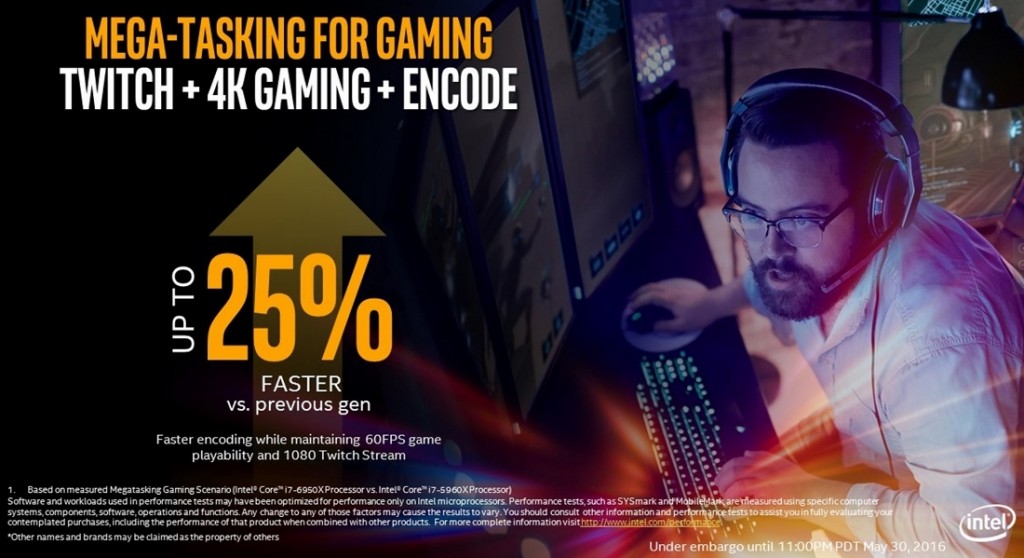
At the same time, Intel also included three new overclocking features into the chip such as per core overclocking, AVX ratio offset, and VccU voltage control. In terms of performance improvements, here are what being claimed by Intel:


Despite being new, the Core i7-6950X still supports the Intel X99 chipset which should be good news to those who already own an X99-based motherboards. Apart from that, Intel also launched several more Broadwell-E processors alongside the Core i7-6950X in the form of an 8-core Core i7-6900K, as well as the 6-core Core i7-6850K and Core i7-6800K.

Here are the general specifications of all four of the Broadwell-E processors that Intel has launched today:


As you can see from the table above, the Core i7-6950X carries a rather hefty price tag . Given that it is the first 10-core desktop processor for consumers, we were not surprised of the price but we do wonder how much will it really cost once it reaches our shores.

Those of you eyeing to get this, you better get your wallet sufficiently prepared.


Monday, May 30, 2016

Gigabyte Aero 14 Laptop – High Performance Gaming Machine In An Ultrabook Body

- No comments


Computex 2016 might only open its doors tomorrow but a number of companies have already begin to announced their offerings for this year’s event. One of them is Gigabyte who has unveiled its brand new, high performance Aero 14 laptop.

Said to be designed for both gamers and professionals, one of Aero 14’s main attraction is its slim physique that has a thickness of just 19.9mm. Judging from products photos that Gigabyte has provided to us, it seems that Aero 14’s design might have been influenced by Aorus – Gigabyte’s own gaming-specific division – who is known for their ultra slim gaming laptop such as thepreviously released X7 Pro, and X5.


In terms of specifications, the Aero 14 features 14-inch QHD (2,560 x 1,440) IPS display alongside Intel Core i7-6700HQ processor and an option of either NVIDIA GeForce GTX 970M or GTX 965M GPU that features 3GB and 2GB GDDR5 VRAM respectively. It also comes with up to 16GB DDR4 RAM and supports up to 32GB of RAM in total.

As for storage, Gigabyte didn’t list down the specific amount but stated that Aero 14 has two M.2 solid state drive slots that support the speedy NVMe PCIe X4 as well as standard SATA interface. The laptop also comes standard with USB 3.1 Type-C and HDMI 2.0 port.

Not to forget, the 1.89kg laptop is also equipped with a 94.24 Wh battery which apparently able to provide Aero 14 with up to 10 hours of battery life. Gigabyte has yet to reveal the availability and pricing info for Aero 14 in our market but nevertheless, we’ll do our best to find out more about them once we see it in action at Computex 2016 later this week.

source : lowyat

Sunday, May 29, 2016

MSI’s VR-Focused Backpack PC

- 1 comment

Ahead of its official unveiling at Computex 2016, MSI has unveiled its headline product to members of the media today. The Backpack PC is MSI’s first product built from the ground up for virtual reality gaming.

The hardware is certainly unique, and from what MSI has revealed so far, it appears to be something like a high-end gaming laptop built as a backpack.


Inside the Backpack PC is a mobile Intel Core i7 Extreme series processor, a desktop-grade Nvidia GeForce GTX 980 GPU, and a user-swappable battery that’s rated for up to 90 minutes of VR gaming.

It weighs 4.5kg, and is designed to be used wirelessly – all ports are located at the top of the backpack. That said, MSI has confirmed that you can continue to use it while plugged in.

Actually, you can even use it as a normal desktop PC. There are enough ports to support an external monitor, headphones, and of course a keyboard and mouse.


On top of that, MSI also stated that the hardware inside can be upgraded by the user – though sadly besides the CPU and GPU, not much else has been revealed so far.

We’ll update the post with more details when MSI shares them, but for now here are some photos of MSI’s futuristic gaming device.


source : lowyat.net